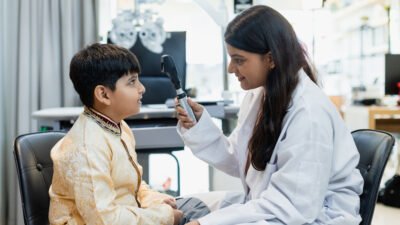


Because sometimes “squinting is cute” isn’t the whole story.
Picture this: You’re at your child’s annual day function, beaming with pride as your little one performs on stage. But instead of confidently looking at the audience, your child is squinting so hard they look like they’re trying to solve a math problem. Sound familiar? If your kid already wears glasses or has been diagnosed with myopia, you might be witnessing something more concerning than stage lights being too bright.
That’s the reality check of progressive myopia, where last month’s spectacle prescription becomes this month’s “Aai, I can’t see the board again.” But don’t worry – knowledge is power, and you’re about to become the detective your child’s vision needs.
Understanding the Problem
Before we dive into detective work, let’s understand what we’re dealing with. Think of myopia like this: imagine your child’s eye is like a camera that’s permanently stuck on “close-up mode.” Everything nearby looks crystal clear – that textbook during homework time, their mobile screen, the rice on their plate. But anything far away? It’s like looking through monsoon fog.
The numbers in India tell a compelling story. Research shows that myopia affects 8.5% of urban children and 6.1% of rural children, with the highest rates found among urban 11-15 year olds. What’s particularly alarming is the significant jump in rural areas, where myopia prevalence has increased from 4.6% to 6.8% in just the last decade.
Did You Know?
Priscilla JJ, Verkicharla PK. Time trends on the prevalence of myopia in India – A prediction model for 2050. Ophthalmic Physiol Opt. 2021 May;41(3):466-474. doi: 10.1111/opo.12806. Epub 2021 Apr 16. PMID: 33860952.
Predictions suggest that myopia prevalence in India will reach 31.89% by 2030 and could touch 48.14% by 2050. Your family certainly isn’t alone in navigating this challenge.
Warning Signs to Watch For
Children rarely complain about blurry vision because it feels normal to them. Instead, watch for these behavioral changes that signal their eyes are struggling.
The Gradual Creep Closer
Your child starts migrating toward whatever they’re trying to see. During online classes, they lean into the screen more than before. TV watching becomes a slow scoot from sofa to floor to practically nose-against-screen. Homework moves from their desk to the dining table for “better light.”
Try this simple test: while traveling, ask your child to read shop signs you can see clearly. If their descriptions are consistently less detailed than yours, take note.
Physical Signs That Matter
Frequent eye rubbing after school indicates strain. Complaints about headaches, especially after homework time, suggest their eyes are working overtime. Constant squinting indoors means they’re struggling to bring distant images into focus.
Changes in Performance
Academic work might suffer subtly – complaints about copying notes incorrectly from the board, reluctance to participate in visual activities, or seeming less engaged in sports they previously enjoyed. Sometimes what looks like attitude is actually vision frustration.
Why This Happens
If you or your spouse wear distance glasses, your child’s risk increases significantly. That’s genetics, not anyone’s fault. What you can influence are lifestyle factors.
Today’s children spend dramatically more time on close-up work – homework, tuition classes, screens – and less time outdoors. Research shows children who get at least two hours of daily outdoor time have slower myopia progression. This doesn’t require expensive activities; playing in your society compound or evening walks count.
Your Action Plan
Get Professional Help
Find an optometrist who practices myopia control. A proper exam goes beyond eye charts to measure eyeball length and assess how both eyes work together.
Modern Treatment Options
Today’s solutions go beyond stronger glasses. Orthokeratology uses special overnight contact lenses to temporarily reshape the cornea. Specialized multifocal lenses and low-dose atropine drops can slow progression while correcting current vision problems.
Daily Habits That Help
Encourage two hours of daily outdoor time. Apply the 20-20-20 rule during close work: every 20 minutes, look at something 20 feet away for 20 seconds. Ensure proper lighting and posture for homework.
The Bottom Line
Recognizing worsening myopia isn’t about anxiety – it’s about being informed. Trust your instincts when something seems different about your child’s vision or behavior.
Childhood myopia is manageable with early intervention. Your role is to notice changes, seek professional help when needed, and support healthy vision habits. By staying alert and acting promptly, you’re giving your child the best foundation for lifelong eye health.
Quick Answers
When should my child have their first eye exam?
At 6 months, 3 years, and before starting school, then every two years unless problems develop. Trust your instincts – if you notice signs, don’t wait.
How can I tell if myopia is worsening?
Watch for moving closer to screens, complaints about distant objects, increased squinting, and changes in school or sports performance.
What can I do to help?
Encourage daily outdoor time, manage screen breaks using the 20-20-20 rule, ensure good lighting for studies, and maintain regular eye check-ups.